The Language That Refused to Be Lost

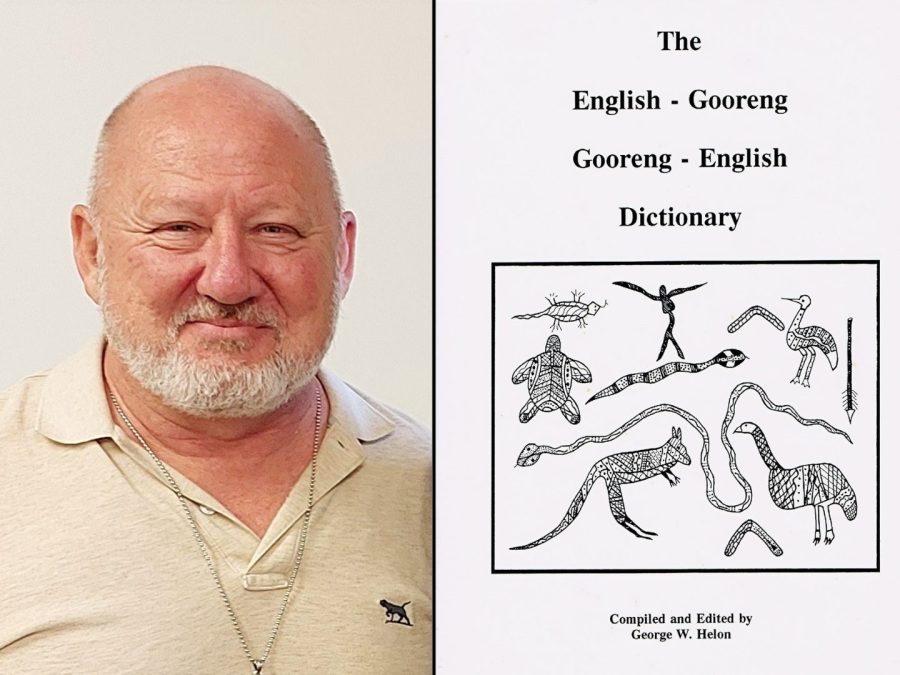
How George W. Helon and Gooreng Gooreng Elders Preserved More Than Words
“The English–Gooreng/Gooreng–English Dictionary will help preserve the language of our people and help them regain their identity, their pride of race and instil a sense of belonging.” — Mervyn Johnson, Gooreng Gooreng Elder and Principal Informant (1994)
“You are the first person to come in and ask us about our history instead of telling us.”
More than thirty years later, George W. Helon still remembers those words. Spoken by Gooreng Gooreng Elder and then Chairperson of the Gurang Land Council (Aboriginal Corporation) Colin Johnson (deceased), they became the foundation of an extraordinary collaboration built on trust, curiosity and a shared determination to preserve a language stretching back to the Dreaming.
The result was The English–Gooreng/Gooreng – English Dictionary, first published in 1994. In recognition of his work, Helon received with much gratitude and respect the Gooreng tribal name Buralnyarla, meaning White Owl.
“Buralnyarla, this means the Keeper of Knowledge,” Helon says with humble pride. “It is the Rufus Owl, the message bird and totem of the Gooreng peoples.”
The Gooreng Gooreng people are the Traditional Custodians of an extensive area of Central Queensland, stretching through the Boyne Valley and the upper Burnett region between the Gladstone hinterland, Eidsvold, Cania and Mount Perry. Their language carries the stories, laws and cultural knowledge of countless generations.
Helon says recording such a language is about far more than just translating words and word lists.
“It’s about preserving history, culture and identity.”
That belief has guided much of his life.
A lifelong curiosity
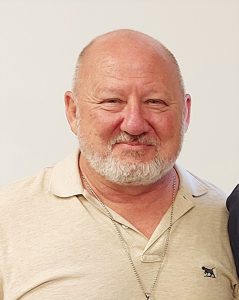 George Helon has always asked questions. Growing up, however, life was not always easy. For years he experienced unexplained episodes of spontaneous laughter that left classmates puzzled and often led to teasing, social isolation, and being branded by teachers as a most disruptive student. It was only much later in life that doctors diagnosed him with an extremely rare genetic disorder called Pallister-Hall Syndrome (PHS), an associated tumour on his pituitary gland and gelastic (or laughing) seizures.
Books became both a refuge and adventure. While others played outside, Helon immersed himself in reading. Every answer sparked another question, every discovery another avenue of research. Knowledge became a lifelong companion, a weapon of choice.
That insatiable curiosity first led him to explore his own Polish family history. Rather than simply tracing names on a family tree, he wanted to understand the lives behind them, where they lived, how they worked, the customs they practised, their place in history and the culture that shaped their identity.
It was an experience that taught him something profound: history, language and culture cannot be separated.
Years later, after moving from Ballarat to Bundaberg and working with Elders of the *Gurang Land Council, that same philosophy would inspire one of his most significant achievements.
Building a dictionary together
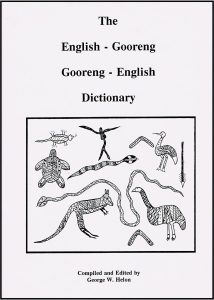 When Helon was approached by Gooreng Elders Colin Johnson and his brother Mervyn (Jukarn) Johnson (Principal informant, 1994 – deceased) with the idea of compiling a Gooreng Gooreng dictionary, he was honoured yet unsure how it would be received by academics and professional linguists alike.
But, not one to shy away from what might seem an insurmountable task he welcomed the proposal.
“You are the first person to come in and ask us about our history instead of telling us,” Colin Johnson said to him.
Those words established the tone for the entire project.
The dictionary was never intended to become an academic curiosity gathering dust on a university shelf. Both Helon and the Elders shared a very different vision.
“They didn’t want a so-called professional taking control of their language by writing it in unintelligible academic gobbledegook,” Helon recalls. “They wanted it preserved so it could be read, understood and taught.”
Boasting with candor Helon recalled how during one of the many trips with Gooreng Elders up north, he heard Uncle Nyulang (Johnson, Principal informant, 1994) in the back seat of the car laughing to himself, before he said:
“Never in my wildest dreams did I think I’d ever hear a whitefella talking my language better than me.”
Although the dictionary took around twelve months to compile, its success depended not simply on research, but on relationships built on mutual respect.
The Elders contributed pronunciation, meanings, cultural knowledge and historical context, elements that no written source alone could ever provide. Like all successful language preservation projects, it became a partnership rather than a translation exercise.
Standing on the shoulders of pioneers
The preservation of Australia’s First Nations languages has a long and fascinating history.
One of its earliest and most significant chapters began at the historic Hermannsburg Mission, established west of Alice Springs in 1877 by German Lutheran missionaries. Realising they could not simply expect Aboriginal people to learn German or English, the missionaries first learned the local language themselves.
Counted among the most influential was Carl Strehlow (1871–1922), who worked closely with Arrernte Elders to develop a written spelling system, record thousands of words, analyse grammar, translate hymns and Bible passages, and document stories, ceremonies and cultural practices. The resulting dictionary became one of Australia’s earliest and most comprehensive records of an Aboriginal language.
Today, scholars increasingly recognise that while Strehlow’s scholarship was significant, its richness depended upon the knowledge generously shared by Arrernte Elders, whose understanding of language, kinship, ceremony and culture made the work possible.
More than a century later, the philosophy behind language preservation has evolved.
Increasingly, Indigenous communities themselves are leading the work of recording, teaching and revitalising their own languages.
A language renaissance
Interest in Australia’s First Nations languages continues to grow. Universities including the Australian National University, the University of Adelaide, Charles Darwin University, the Batchelor Institute of Indigenous Tertiary Education and the University of Sydney now teach Indigenous languages, linguistics and language revitalisation. Their work reflects a growing national recognition that language is not simply a communication tool—it is a repository of history, identity and cultural memory.
Although there is currently no dedicated university course in Gooreng Gooreng, Helon’s dictionary represents an important foundation upon which future generations can continue to build.
More than a dictionary
For George Helon, **The English–Gooreng/Gooreng–English Dictionary has never been simply a collection of words. It is a significant record of a culture. It is a bridge between generations. It is evidence that identity can be connected, strengthened and preserved through language.
Perhaps Mervyn Johnson said it best when he wrote in the opening pages of the dictionary:
“The Gooreng Gooreng language is the language of our fathers, their fathers and countless generations before them—it stretches back to our Dreamtime. There is power and life in our language.”
“It’s 32 years now, since I wrote the Dictionary”, Helon said.
“I’m happy that it’s still being talked about and sparking the curiosity of those generations since.”
Discover this dictionary and many more at The Language People bookshop or browse our collection online.
* Gurang was used before Gooreng was discovered to be the authentic pronuncation.
** Containing over 650 words, the contents of The English-Gooreng/Gooreng-English Dictionary include: a Guide to Pronunciations, an Introduction by the Author, Statements by Gooreng- Gooreng Elders and Informants Mervyn (Jukarn) Johnson and Nyulang Johnson, and a Declaration and Endorsement by Gooreng Gooreng Elders.
Article by