Susan Boyer (1953–2022): A Pioneer in Developing Everyday Australian English Language

By the 1990s, the time had long passed when Australia relied upon its British heritage to define its character. While many political and institutional systems still reflected the country’s European settlement, culturally, modern Australia had developed a personality of its own, and in turn, a language of its own¹.
Yet remnants of that British inheritance remained in unexpected places. In the field of English as a Second Language teaching, many of the resources available to teachers had little relationship to contemporary Australian life or to the English their students encountered beyond the classroom.
A few educators such as Susan Boyer saw the need for change.
Susan recognised a significant gap between the English taught in textbooks and the language her students encountered in everyday Australian life. In the mid-90s, she began developing material that would eventually become a distinctly Australian collection of English-language resources.
From those modest beginnings, the educator, researcher and author went on to write more than 20 non-fiction titles and establish Boyer Educational Resources with her husband, Len.
Susan and Len met in 1993 and married the following year. At the time, Susan was teaching ESL part-time at TAFE, where she saw how students could arrive in Australia believing their English was adequate, only to discover they could barely understand what Australians were saying.
Australians were “flat out”, shop assistants asked, “Are you right?” and people said, “Just a tick”. Such expressions were everywhere — in shops, doctors’ surgeries, workplaces, lectures and the media.
Susan began writing and recording realistic conversations based on situations her students might actually encounter: phoning a friend, going to a barbecue or calling a tradesperson.
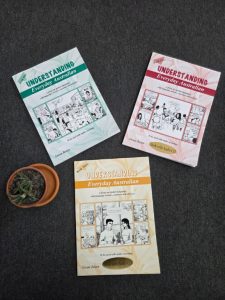 Her students loved them. Encouraged by their response, and having completed a Master’s degree in Language and Literacy, Susan submitted what would become Understanding Everyday Australian to major international publishers.
The response was frustrating. Publishers could see merit in the idea, she later recalled in a potential script for ABC broadcaster Richard Fidler’s Conversations, but considered Australia too small a market.
Susan’s response was characteristically practical.
“OK, we can publish ourselves,” she decided.
She told Len that if they printed 500 copies, she believed they would sell enough to cover their costs.
It was a leap of faith — and a steep learning curve.
“We started from a zero base,” Len recalls.
Neither had publishing experience. Together they learnt about book formatting, ISBNs, printing, distribution, cover design, illustrations and recording realistic conversations.
Susan drove the writing, creation and promotion, while Len — drawing on his accounting background — became facilitator, proofreader and formatter. He also became, as he jokingly describes himself, Susan’s “crash test dummy”, testing whether activities and instructions actually worked.
Behind the business, however, was a marriage.
“We had a deep love and care for each other and this blended into a great working partnership,” Len says.
Their gamble paid off.
The first 500 copies of Understanding Everyday Australian – Book One, published in 1998, sold quickly.
Then came requests for more.
Susan already had more conversations “up my sleeve”, as she put it, and Books 2 and 3 followed.
Writing became deeply absorbing for her. During difficult periods in her family life, Susan described losing herself in the creative process — sometimes getting up during sleepless nights to write for hours.
She was not simply teaching English. She was creating characters, situations and conversations that reflected the Australia her students were actually experiencing.
Success, however, still required persistence.
As a self-publisher, Susan personally approached bookshops and colleges. Some welcomed her enthusiastically; others were dismissive.
She was unfazed.
“If someone says ‘no’, that’s OK,” she wrote. “I don’t take it personally.”
Eventually, her reputation became strong enough for a university publisher to approach her about creating an international version of Understanding Everyday Australian. But by then Susan and Len had learnt the publishing business for themselves.
Rather than surrender control for a seven per cent royalty, they chose to remain independent.
Susan Boyer’s achievement was not simply to produce English textbooks. She recognised that learning a language also means understanding how people actually speak, and the culture behind their words.
By bringing Australian voices, humour and everyday situations into the ESL classroom, she helped bridge the gap between formal English and the language newcomers encountered around them.
What began with 500 copies of Understanding Everyday Australian grew into more than 20 titles and a publishing business built with Len. Susan died in 2022, but her work continues to capture a changing Australia — and the everyday language that helped make it home.
¹ In 1947, the Australian Government established the Adult Migrant English Program (AMEP) to provide English instruction to newly arrived migrants. During the 1950s and 1960s, teaching commonly relied on “Situational English”: an approach centred on grammar, repetition and structured classroom situations. By the 1970s and 1980s, there was a shift towards Communicative Language Teaching, with greater emphasis on conversation and practical communication. It was against this changing backdrop that Susan Boyer identified a further gap: learners needed not only functional English, but an understanding of the language they would actually hear in everyday Australian life. (More information here: https://www.cal.org/caela/esl_resources/digests/AUSQA.html
Article by