Struth, we’ve lost some cracking words

Personal intro:
Hang on a tick ….
Fancy coming down a linguistic rabbit hole with me?
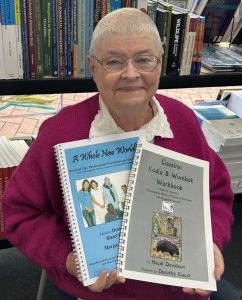
Over the past few months, I’ve been writing about the educators who helped bring Australian English into the English-language classroom — giving learners an alternative to the more traditional British English found in textbooks such as those from Cambridge. Along the way, I kept coming across words and expressions that were unmistakably Australian. Some are still part of everyday conversation; others have all but disappeared. It got me wondering: what happened to all those wonderfully colourful expressions Australians once tossed around without a second thought? That question sent me down a linguistic rabbit hole, tracing some of our colloquialisms through the decades — and uncovering a few cracking expressions that might just deserve another outing.
There was a time when an Australian didn’t simply say something was genuine. It was ridgey-didge. (truth – I still use this).
You didn’t necessarily ask for the latest news. You asked, “What’s the drum?”
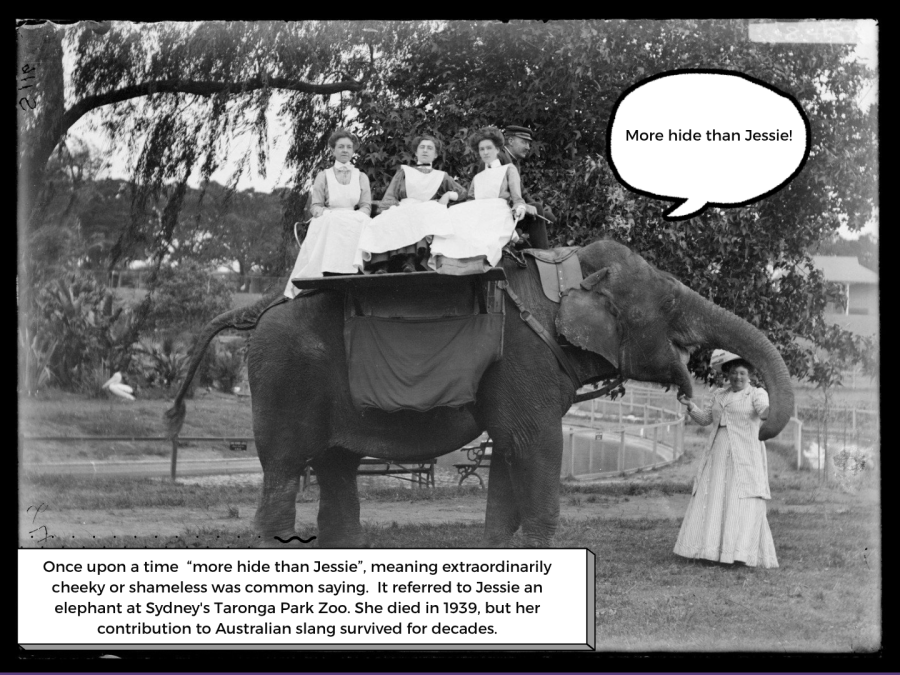
If someone had eaten rather too enthusiastically, they might be full up to Dolly’s wax. (i’ve never heard of this one ) And if a person was being particularly cheeky, they could have more hide than Jessie (ditto for this too).
Try slipping any of those into conversation today and you may be met with a blank stare.
Australian English has always been a restless creature. Words arrive, flourish for a generation or two, and then quietly disappear. Some vanish because the objects or customs they described have gone. Others simply fall out of fashion.
Take “full up to Dolly’s wax”. The expression meant completely full, and referred to dolls with wax heads. As the dolls disappeared from everyday life, so did the metaphor. “The man outside Hoyts” is another lost expression, once referring to someone who seemed to know everything that was going on — a reference to the commissionaire stationed outside Hoyts cinemas.
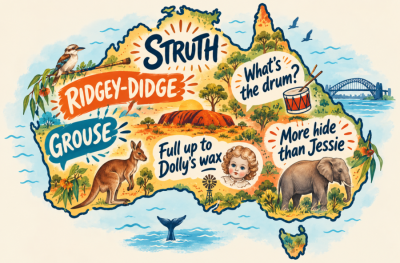 Then there is “more hide than Jessie”, meaning extraordinarily cheeky or shameless. Jessie was an elephant at Sydney’s Taronga Park Zoo. She died in 1939, but her contribution to Australian slang survived for decades.
These expressions are funny, but they are also little pieces of social history.
They tell us what Australians watched, bought, ate, feared, admired and laughed about. They are linguistic fossils, preserving a world that can otherwise be surprisingly difficult to see.
And perhaps we should bring some of them back.
Not all of them, obviously. Language can’t be preserved in a jar, and nobody wants to sound as though they have wandered out of a 1950s radio serial. But a little revival might do us good.
Imagine a politician being described as having “more hide than Jessie”. Imagine a restaurant review declaring the meal “ridgey-didge”. Imagine answering the office question “What’s happening?” with a cheerful “What’s the drum?”
The beauty of old Australian slang is that it doesn’t take itself too seriously. It is earthy, inventive and often gloriously absurd.
It also reminds us that language belongs to everybody. Today’s slang will eventually sound quaint to somebody. The expressions we use without thinking — “awesome”, “no worries”, “legend” — may one day require an explanatory footnote.
That’s how language works. It changes because we change.
But perhaps we don’t have to let every good expression disappear.
So, the next time someone asks whether everything is okay, tell them it’s grouse. If something is unquestionably authentic, call it ridgey-didge. And if you’ve had an enormous lunch, don’t merely say you’re full.
Declare yourself full up to Dolly’s wax.
It may confuse people.
But isn’t that how new slang starts?
Article by